
Outline of a theory of practice
In Outline of a Theory of Practice, Bourdieu questions the preeminent ideas of social anthropologists such as Levi-Strauss who stressed the structural principles governing human action rather than the actions themselves and, Bourdieu asserts, doesn’t account for all observable nuances of behaviour. Drawing on his fieldwork in Algeria, he expresses the need for a theory of practice focusing on…
- Edisi
- Cetakan Pertama
- ISBN/ISSN
- 0-521-29164-x
- Deskripsi Fisik
- vii + 248 halaman; 21 cm
- Judul Seri
- -
- No. Panggil
- 301.2 BOU o
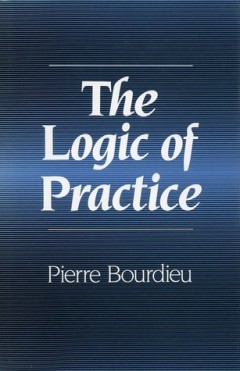
The logic of practice
Our usual representations of the opposition between the "civilized" and the "primitive" derive from willfully ignoring the relationship of distance our social science sets up between the observer and the observed. In fact, the author argues, the relationship between the anthropologist and his object of study is a particular instance of the relationship between knowing and doing, interpreting an…
- Edisi
- Cetakan Pertama
- ISBN/ISSN
- 0-7456-0597-4
- Deskripsi Fisik
- 333 halaman; 20.3 cm
- Judul Seri
- -
- No. Panggil
- 160 PIE t

Pascalian Meditations
If I have resolved to ask some questions that I would rather have left to philosophy, it is because it seemed to me that philosophy, for all its questioning, did not ask them; and because, especially with re-spect to the social sciences, it never ceased to raise questions that did not seem to me to be essential - while avoiding asking itself about the reasons and above all the (often not very p…
- Edisi
- Cetakan Pertama
- ISBN/ISSN
- 0-7456-2054-x
- Deskripsi Fisik
- 256 halaman; 21 cm
- Judul Seri
- -
- No. Panggil
- 158 BOU p

Language and symbolic power
This volume brings together Pierre Bourdieu’s highly original writings on language and on the relations among language, power, and politics. Bourdieu develops a forceful critique of traditional approaches to language, including the linguistic theories of Saussure and Chomsky and the theory of speech-acts elaborated by Austin and others. He argues that language should be viewed not only as a m…
- Edisi
- Cetakan Pertama
- ISBN/ISSN
- 0-674-51041-0
- Deskripsi Fisik
- ix + 302 halaman; 21 cm
- Judul Seri
- -
- No. Panggil
- 400 BOU l


 Film
Film
 Film TA
 Film Dinas Kebudayaan
 Film Dokumenter